Section 1. Model presentation
The 21st century is currently undergoing a societal digital transformation, where technological innovations and generative artificial intelligence are both a significant challenge and a catalyst for change (OECD, 2018, 2019). At the same time, these innovations serve as valuable resources for the professional development of teachers and the enhancement of new competences (King, French, & Halligan, 2022; Popova, Evans, Breeding, & Arancibia, 2022; OECD, 2024).
The development of effective, informed, and competent teachers cannot overlook these changes and the emergence of new digital tools that are capable of driving meaningful transformations in the teaching-learning process, in both initial and in-service teacher training, as well as in teachers’ professional growth. Among these tools, self-assessment is a key element of professional development. It enables teachers to reflect on their teaching practices, identify strengths and weaknesses, and enhance instructional effectiveness. Self-assessment provides a structured approach for teachers to evaluate their performance and make informed decisions about their teaching strategies (Bandura, 1997). Through self-reflection, teachers can adjust to the needs of their students and improve learning outcomes (Council of the European Union, 2020), now further supported by digital technologies and artificial intelligence.
This fundamental belief is also the inspiration behind the AIDA project. AIDA stands for “Artificial Intelligence Assistant and Digital Self-Assessment for Teachers’ Continuing Professional Development” an Erasmus+ project that aims to develop a Digital Self-Assessment Model for Teachers (DIG.S-AM4T). This model was created through a systematic review of international reference literature and the evidence generated by educational research on teacher professional learning and development.
The Digital Self-Assessment Model for Teachers (DIG.S-AM4T) consists of six competence areas:
- Teaching competences
- Digital competences
- Teacher leadership and mentoring competences
- Relationship competences
- Inclusive competences
- Reflective competences
These areas represent the diverse skills and tasks that are required of teachers in order to effectively perform in schools that are continuously evolving (Section 2). Each competence area is described through a set of competence indicators (or standards), presented as “statements” fundamental to the area of competence to which they are issued. Each statement begins with the phrase “I can...” prompting teachers to assess their competence level by using a 7-point Likert scale. This scale progressively measures the degree of competence perceived by the teacher at that specific point in his/her career. On the Likert scale, level 1 signifies a lack of competence, while level 7 indicates a high level of proficiency (Section 3).
After completing the self-assessment by marking the perceived level of proficiency for each statement, the teacher will receive feedback on the strengths and weaknesses identified during the self-assessment process. This feedback will guide the improvement of his/her competences, with the support of artificial intelligence, in alignment with the goal of continuous professional development (Section 4).
Section 2. Competence Areas for teacher self-assessment and professional development
The six areas of competence, illustrated in Figure 1, represent essential skills for teaching professionalism, as outlined in international reference literature. These areas of competence are linked to forms of expertise required for effective teaching. However, they should not be viewed as rigid categories, but rather as flexible dimensions that can evolve, allowing teachers' professionalism to adapt to the educational needs of young generations and the demands of contemporary society.
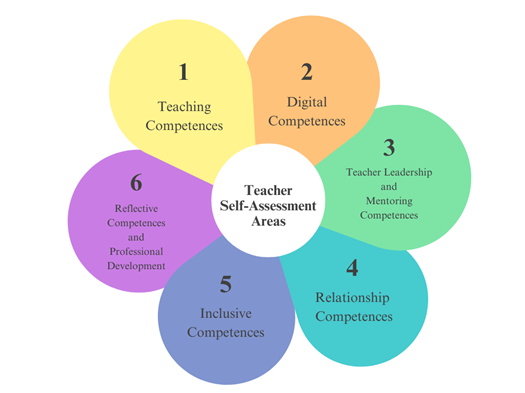
Figure 1. DIG.S-AM4T competence areas for teacher self-assessment and professional development
Section 3. Competence areas and indicators
In this section, for each competence area of the model, a set of competence indicators is provided, allowing teachers to self-assess using a 7-point Likert scale. To ensure clarity regarding each competence area, the following elements are included: a definition derived from the international literature, a list of competence indicators specific to the area under consideration, and concise explanations for each point on the Likert scale (ranging from (1) “I can’t do it” to (7) “I can do it proficiently”).
Please use the following competence indicators to assess your current level in each of the areas listed below.
Section 4. Self-assessment process feedback
This section provides feedback at the conclusion of the teacher self-assessment process, based on the proficiency levels assigned by the teacher for each competence indicator in the areas outlined in Section 3 of the model. The following analyses are provided:
The arithmetic mean of the scores for each competence area.
The frequency distribution of scores across the Likert scale levels for each competence area.
The arithmetic mean of scores across all competence areas in the model.
Radar charts illustrating the scores for the competence areas in the model.
The data presented in this section does not predict the teacher’s level of competence, but it offers valuable insights into the professional development of the teacher who participated in the self-assessment process using the DIG.S-AM4T model.